Pular para o conteúdo principal

Blog da Chris

Categorias
Blog

Nel mercato del gioco d’azzardo online, la tutela dei dati personali non è soltanto una questione di

Introduzione: La Sfida della Privacy nel mondo del Gioco Digitale

Nel mercato del gioco d’azzardo online, la tutela dei dati personali non è soltanto una questione di conformità normativa, ma una componente fondamentale per costruire fiducia e rafforzare la reputazione delle piattaforme. Con l’aumento della digitalizzazione e delle tecnologie di analisi dei comportamenti degli utenti, le aziende devono adottare politiche trasparenti e sure, in linea con le normative europee, come il Regolamento Generale sulla Protezione dei Dati (GDPR).

Importanza della Conformità alla Normativa sulla Privacy

L’industria del gambling online si distingue per un elevato livello di regolamentazione, che mira a proteggere non solo la sicurezza finanziaria ma anche i diritti dei giocatori. La conformità alle normative sulla privacy, come evidenziato dall’articolo leggi l’informativa, rappresenta un pilastro di credibilità e di strategic compliance.

Secondo uno studio condotto da European Gaming & Betting Association, il 78% degli utenti preferisce piattaforme che dimostrano trasparenza circa l’uso dei propri dati, sintomo di una crescente consapevolezza e responsabilità nel settore.

Elementi Chiave della Privacy Policy nelle Piattaforme di Gioco

Una Privacy Policy efficace e aggiornata deve comprendere diversi aspetti cruciali, tra cui:

  • Tipologia di dati raccolti: informazioni di identificazione, dati di pagamento, cronologia di gioco.
  • Finalità del trattamento: migliorare l’esperienza utente, prevenire frodi, conformarsi a obblighi legali.
  • Misure di sicurezza: crittografia dei dati, controlli di accesso, audit periodici.
  • Diritti degli utenti: accesso, rettifica, cancellazione, opposizione alla profilazione.

Ad esempio, piattaforme che implementano l’autenticazione a due fattori e strumenti di anonimizzazione contribuiscono a elevare il livello di tutela, favorendo così un ambiente più sicuro per i giocatori.

Ruolo della Trasparenza e della Documentazione

L’efficacia di qualsiasi strategia di privacy si basa sulla trasparenza comunicativa. La possibilità di leggi l’informativa rappresenta il documento di garanzia più importante. Una policy dettagliata, facilmente accessibile e comprensibile, permette all’utente di essere consapevole delle modalità di trattamento dei propri dati.

Inoltre, le aziende devono aggiornare regolarmente le loro policy in risposta a nuove normative, come le recenti direttive dell’UE sulla protezione dei dati personali o le best practice del settore. Un esempio concreto: molte piattaforme hanno adottato strumenti di consenso granulare che permettono all’utente di scegliere quale trattamento autorizzare.

Innovazioni e Best Practice: Dalla Data Governance alla User Experience

Approccio Descrizione Esempio Pratico
Data Minimization Raccolta solo dei dati indispensabili Implementazione di dashboards che richiedono solo informazioni essenziali
Privacy by Design Incorporare la privacy nella progettazione del software Processi di verifica automatica dell’accesso ai dati sensibili
Coinvolgimento attivo degli utenti Trasparenza sul trattamento dei dati e possibilità di personalizzare le preferenze Notifiche push e banner di consenso dinamici

Questi approcci rappresentano il massimo livello di maturità strategica, contribuendo non solo alla conformità legale, ma anche a migliorare l’esperienza dell’utente, elemento chiave nel settore del gioco digitale.

Conclusioni: La Sostenibilità del Gioco Responsabile e della Privacy

Garantire la privacy dei dati non può essere considerato unicamente un obbligo legale, ma un elemento fondante del gioco responsabile e sostenibile. La fiducia degli utenti si costruisce attraverso costanti pratiche di trasparenza e rispetto delle normative, come evidenziato nell’leggi l’informativa.

Per le aziende del settore, investire nella qualità della privacy policies e nelle tecniche di protezione dei dati rappresenta un vantaggio competitivo, capace di attrarre e fidelizzare un pubblico sempre più consapevole e attento alla gestione della propria identità digitale.

Categorias
Blog

Mastering Digital Fishing Experiences: The Evolution of Virtual Angling and the Rise of Authentic Play

Over recent years, the landscape of recreational fishing has experienced a fascinating transformation, paralleling advances in digital entertainment and virtual simulation technology. Traditionally, fishing has been rooted in physical outdoor activities that demand patience, skill, and a genuine connection to nature. However, the advent of sophisticated online fishing games and virtual simulations has democratized access, allowing enthusiasts worldwide to indulge in their passion from the comfort of their homes or on-the-go devices.

The Rise of Virtual Fishing: Merging Technology with Tradition

Virtual fishing games have evolved dramatically since their inception, transitioning from simple pixelated experiences to rich, immersive environments that emulate real-world fishing scenarios with remarkable accuracy. Industry analysts estimate that the global online fishing game market has grown at an annual compound rate of approximately 12% over the past five years, driven by technological innovations and increasing smartphone penetration.

Particularly notable are titles that blend realistic graphics with strategic gameplay, appealing to both casual players and serious anglers seeking to refine their skills or simply enjoy the thrill of the catch without leaving their living rooms.

Bridging the Gap: Authenticity and Educational Value

While entertainment remains a primary driver, modern virtual fishing platforms are increasingly recognised for their educational and skill-building potential. They help newcomers learn about different fish species, tackle, and local environments, fostering a deeper appreciation of aquatic ecosystems. For seasoned anglers, these platforms offer a valuable arena for experimenting with tactics and techniques in a risk-free setting.

Furthermore, many virtual games incorporate data-driven mechanics, such as fish behaviour patterns and environmental conditions, to heighten realism and strategic depth. These features lay the groundwork for potential professional training tools and tourism promotions that leverage gamification to attract new audiences.

The Significance of Authentic Play: The Case for Credible Virtual Experiences

Not all virtual fishing experiences are created equal. Authenticity in simulation plays a pivotal role in engaging users and providing meaningful learning opportunities. Herein lies a crucial intersection between gaming and real-world fishing: credible digital platforms that offer free play modes resembling actual fishing challenges elevate user trust and foster community development.

In this context, platforms that allow users to enjoy “Big Bass Trophy Fishing free play” serve as a prime example. They provide a realistic environment where players can hone their skills, understand aquatic behaviours, and engage in strategic decision-making—often mirroring real-world fishing dynamics. Such credible experiences are invaluable for beginners seeking to grasp fundamental concepts and for enthusiasts chasing mastery.

Technological Innovations Driving Virtual Angling

Innovation Impact on Virtual Fishing Real-World Application
Augmented Reality (AR) Enhances immersion by overlaying virtual fish and environments onto real-world backgrounds Mobile AR fishing apps encouraging outdoor activity
High-Definition Graphics & Physics Creates lifelike aquatic ecosystems and fish behaviour Training simulators for professional anglers
Artificial Intelligence (AI) Simulates realistic fish responses and environmental shifts Customisable virtual tournaments and adaptive challenges

Integrating Virtual and Real-World Fishing: Opportunities and Challenges

The synergy between virtual experiences and actual fishing pursuits opens numerous opportunities for industry stakeholders, from equipment manufacturers to tourism boards. Interactive digital platforms foster community bonding, skill development, and curiosity about conservation efforts.

However, challenges persist in ensuring these platforms maintain credibility and do not replace authentic outdoor fishing but rather complement it, especially in promoting sustainable practices and environmental awareness. Notably, credible platforms offering free play options like Big Bass Trophy Fishing free play exemplify this balanced approach by providing realistic simulation experiences that educate and entertain simultaneously.

The Future Outlook: Enhancing Credibility and Accessibility in Virtual Fishing

Looking ahead, industry experts anticipate an increasing integration of virtual and augmented reality with existing online platforms, making virtual fishing experiences more immersive and accessible than ever before. As data analytics and user feedback inform development, credible platforms with authentic gameplay will remain central to engaging wider audiences and inspiring future generations of anglers.

Furthermore, collaborations between digital developers and conservation organisations could promote sustainable fishing practices via virtual channels, reinforcing responsible angling insights for novices and veterans alike.

Conclusion: Navigating the Digital Waters with Credibility

The evolution of virtual fishing encapsulates a broader trend within digital recreation: the pursuit of authenticity and meaningful engagement amidst entertainment. Platforms that balance realism with accessibility, such as those offering credible “free play” modes, serve as vital gateways for education, skill development, and fostering a community of responsible anglers.

As technology continues to propel virtual experiences forward, the intersection of digital innovation and traditional angling promises to enrich our understanding of aquatic ecosystems while providing endless opportunities for enjoyment. For those eager to explore these worlds, an excellent starting point is the Big Bass Trophy Fishing free play platform, where immersive, credible gameplay awaits.

Categorias
Blog

Preserving Literary Legacies in a Digital Era: The Role of Authentic Archival Resources

In an age where digital transformation is redefining how we engage with cultural heritage, the stewardship of literary legacies remains a cornerstone of intellectual preservation. While contemporary publishing accelerates dissemination, it often risks diluting the depth and authenticity embedded within original texts and their historical contexts. To navigate this landscape, discerning scholars and avid readers alike look toward credible archival sources that maintain integrity and scholarly rigour.

The Imperative for Authentic Preservation in Literary Heritage

Understanding the importance of preserving literary legacies extends beyond mere archival storage—it involves curating collections that reflect the nuanced contexts in which works were created. Such archives serve as vital touchpoints for research, education, and cultural continuity. As Dr. Amelia Hart, a prominent historian of literature, notes, “Authentic archives serve as the custodians of nuance, language, and cultural momentum that define a nation’s literary patrimony.

Given the proliferation of digital content—ranging from photocopies to unofficial reproductions—the need for reputable sources has never been more urgent. Fake reproductions, misattributions, and incomplete digitizations threaten to distort historical narratives and obscure authors’ original intentions.

Case Study: The Role of Dedicated Literary Archives

Consider established archives such as the British Library’s digitised collections or Project Gutenberg. While accessible, these repositories sometimes lack the curated contextual analyses that scholars depend on when examining legacy texts. Dedicated platforms that blend comprehensive digitization with scholarly curation provide an essential service by ensuring that digital reproductions are not only faithful but also richly contextualized.

Example: The Rise of Frogs Books Legacy offers an extensive collection of historical literary works, accompanied by scholarly commentary and provenance details that authenticate each piece’s significance.

Evaluating Credibility: What Makes a Digital Archive Truly Authoritative?

Criteria Industry Standards & Indicators Application in Practice
Authenticity & Provenance Clear documentation of origin and restoration processes Archival records certified by experts, transparent sourcing
Scholarly Input Involvement of recognised academics in curation Peer-reviewed annotations and analyses
Technical Fidelity High-resolution scans, OCR accuracy, minimal distortion Digital reproductions faithfully representing original formats
User Engagement Accessible metadata, contextual backgrounds, interactivity Comprehensive search, cross-referencing, and educational tools

The Future of Literary Preservation: Beyond Digitisation

While digital archives have revolutionised access, the challenge lies in maintaining the authenticity and scholarly value of these collections. Emerging trends include augmented reality (AR) exhibits that contextualise texts in physical environments and blockchain-based provenance tracking to authenticate editions and manuscripts.

Institutions and independent projects like Rise of Frogs Books Legacy exemplify this commitment by blending modern digital techniques with scholarly diligence. Their work ensures that future generations will have access to unadulterated, well-preserved literary artifacts—critical for ongoing scholarship and cultural identity.

Authoritative Resources as Pillars of Cultural Integrity

“In an era awash with digital information, authenticity remains the bedrock of meaningful engagement with our literary heritage.” — Professor Liam Montgomery, Digital Humanities Expert

For those invested in the true preservation of literary history, platforms like Rise of Frogs Books Legacy serve as essential gateways—combining rigor, authenticity, and scholarly insight into a seamless digital experience.

Conclusion

As custodians of our shared cultural and literary history, the importance of discerning credible archives cannot be overstated. They ensure not only that our past remains intact but that it continues to inspire and educate with unwavering integrity. In this pursuit, dedicated repositories—such as the Rise of Frogs Books Legacy—stand as exemplars of scholarly commitment and digital innovation, safeguarding the genuine essence of literary heritage for generations to come.

Categorias
Blog

Literary archives serve as repositories of authors’ manuscripts, correspondence, personal diaries, a

Understanding Literary Archives: Custodians of Cultural Memory

Literary archives serve as repositories of authors’ manuscripts, correspondence, personal diaries, and related materials. They function as crucial nodes in the network of cultural memory, enabling historians, scholars, and readers to access primary sources that illuminate literary histories and societal contexts. The integrity, accessibility, and comprehensiveness of these archives directly impact the fidelity with which culture’s stories are preserved and interpreted.

Modern digital archiving initiatives augment traditional collections through enhanced discoverability and preservation. However, the quality of these digital archives is indelibly tied to the expertise and standards upheld by the organisations responsible for their curation.

The Role of Digital Preservation in Literary Studies

Recent advancements have enabled archives to surpass physical limitations, providing global accessibility to rare and fragile materials. This shift is particularly vital for marginalized voices and lesser-known authors whose works might otherwise be lost to time.

Digital archives facilitate cross-referential research, visualisations of textual variants, and contextual analyses. Commitment to E-E-A-T (Experience, Expertise, Authority, Trustworthiness) becomes paramount to ensure that digital collections are credible sources that scholars can depend on for accurate data and interpretations.

In this landscape, specialized platforms and repositories that combine scholarly rigor with technological robustness stand out as models of excellence. For example, this resource exemplifies a dedicated approach to cataloguing and preserving literary artefacts, particularly focusing on early 20th-century works that have shaped modern literary narratives.

Case Study: The Rise of Frogs Books Legacy

The website https://rise-of-frogs-books-legacy.com/ epitomizes a specialized digital archive committed to safeguarding and disseminating rare literary works. This platform offers scholars an authoritative, meticulously curated collection of texts and supplementary materials. Its significance lies not merely in the quantity of archived content but in the rigorous standards applied to ensure authenticity and long-term preservation.

By integrating advanced metadata standards, detailed provenance documentation, and open-access principles, the Rise of Frogs Books Legacy enriches contemporary understanding of literary history. Its dedication aligns with emerging best practices in digital humanities — emphasizing user trust, scholarly integrity, and operational transparency.

Digital Archives as Catalysts for Cultural Dialogue

Beyond preservation, literary archives catalyse cultural dialogue by making significant works accessible across generations and geographies. They enable comparative studies, inspire new creative interpretations, and support language revitalization efforts. This role underscores the importance of consolidating educational initiatives and technological innovation within trusted digital repositories.

In an era where misinformation and digital obfuscation threaten historical clarity, authoritative archives become anchors of credibility. They foster a sense of collective ownership over cultural narratives, ensuring that future generations continue to learn from authentic sources.

Conclusion: Embracing the Future of Literary Preservation

As digital technologies evolve, the stewardship of literary legacy must evolve in tandem. Trusted, expert-led archives, like the Rise of Frogs Books Legacy, stand at the forefront, ensuring that cultural heritage remains resilient against the fragmenting forces of time and technology.

Investing in such credible repositories is not merely an act of preservation but a commitment to the ongoing vitality of literary arts and cultural identity. Their role in fostering informed, critical engagement with the past underscores the enduring power of well-curated digital archives in shaping our collective memory.

Categorias
Blog

Deputado do União Brasil ainda não “bateu o martelo” em relação a Allyson Bezerra.

Na última quarta-feira, 30 de julho, o deputado estadual Ivanilson Oliveira (União) participou de evento na nova praça do bairro Aeroporto, em Mossoró, a convite do vereador e seu apoiador, Wiginis do Gás (União Brasil).

Na ocasião, o deputado concedeu entrevista ao jornalista Joãozinho GPS, da rádio Difusora AM. A entrevista movimentou o cenário político. Ivanilson é do mesmo partido do prefeito Allyson Bezerra, pré-candidato ao governo do Estado, mas quando perguntado sobre seu apoio ao projeto do prefeito de Mossoró, o parlamentar disse que ainda não tem nada definido.

Allyson é um dos candidatos mais favoritos.  A gente tem conversado, faltam alguns detalhes, mas definir mesmo, a gente ainda não definiu”, disse o parlamentar

E declarou que os outros pré-candidatos ele já definiu, se referindo ao Senado. Vai apoiar à reeleição de Zenaide Maia (PSD) e à candidatura da governadora Fátima Bezerra (PT).

A chapa está pronta. Zenaide e Fátima Bezerra. Isso aqui é assunto superado. Eu só tenho uma palavra”.

Acompanhe o Blog da Chris pelo Instagram 

Categorias
Blog

Emissão da nova identidade passa a contar com 75 vagas por semana na Câmara

A partir desta sexta-feira, 1º de agosto, a Câmara Municipal de Mossoró (CMM) vai passar a disponibilizar 75 vagas semanais (antes eram 50) para agendamento on-line da nova Carteira de Identidade Nacional (CIN).

Os agendamentos podem ser feitos por meio do site documentocidadao.mossoro.rn.leg.brAs vagas para agendamento são renovadas toda sexta-feira, ao meio-dia. Para garantir a vaga, é necessário acessar a plataforma, preencher os dados pessoais e escolher o dia e horário para atendimento.

A partir de agora, serão abertas 75 vagas por semana para emissão da nova carteira, sendo 30% reservadas para pessoas com deficiência, que terão prioridade no atendimento. O serviço é realizado no Setor de Atendimento ao Cidadão, com acesso pela Rua Santos Dumont, de segunda a sexta-feira, das 8h às 13h, exclusivamente mediante agendamento.

A Nova Carteira de Identidade Nacional integra documentos como CPF e CNH em um só, oferecendo mais praticidade e segurança. O novo modelo segue normas internacionais e inclui o código MRZ (utilizado em passaportes), o que facilitará a identificação em países do Mercosul.

Confira a documentação necessária:

  • Certidão de nascimento ou casamento (ORIGINAL)
  • Comprovante de residência (ORIGINAL)
  • CPF
  • Boletim de ocorrência (em caso de 2ª via)

Documentação opcional:

  • Título de Eleitor
  • Reservista
  • Cartão SUS
  • NIS/PIS/PASEP
  • Carteira de Trabalho
  • Carteira de Identificação Profissional
  • Classificação Sanguínea
  • CNHAcompanhe
Categorias
Blog

Ufersa concede título Dra. Honoris Causa a Marina Silva

O Conselho Universitário – CONSUNI da Universidade Federal Rural do Semi-Árido (Ufersa) aprovou a concessão do Título de Doutora Honoris Causa à senhora Maria Osmaria da Silva Vaz de Lima, publicamente reconhecida como Marina Silva, atual ministra de Estado do Meio Ambiente e Mudança do Clima do Governo Federal.

A decisão foi tomada durante a sétima Reunião Ordinária de 2025, na tarde desta quinta-feira, dia 31 de julho, véspera do aniversário de 20 anos de transformação da Escola Superior de Agricultura de Mossoró (ESAM) em Universidade, por força da Lei Nº 11.155, sancionada em 2005 pelo presidente Luís Inácio Lula da Silva.

A data para entrega do título está marcada para o dia 29 de agosto, quando acontecerá a Assembleia Universitária pelos 20 anos de transformação da Ufersa.

Marina Silva é professora, ambientalista e política, formada em História e com especialização em Psicopedagogia e Teoria Psicanalítica. Na vida política, já ocupou os cargos de vereadora, deputada estadual, deputada federal, senadora e ministra do Meio Ambiente. A honraria concedida pela Ufersa se soma a dezenas de títulos e prêmios nacionais e internacionais, entre eles, o de Dra. Honoris Causa pela UFBA e pela Academia Chinesa de Silvicultura.

Categorias
Blog

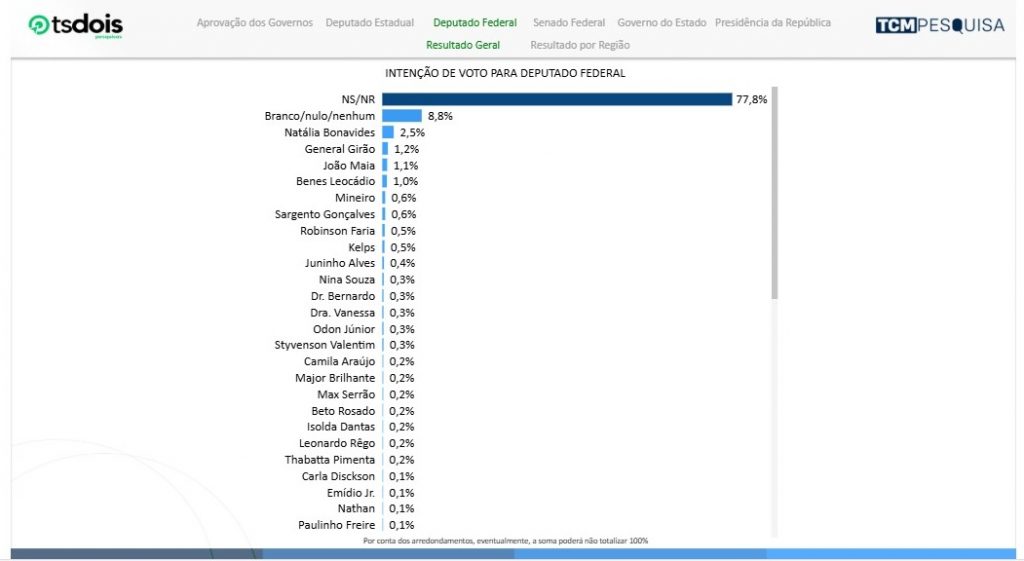
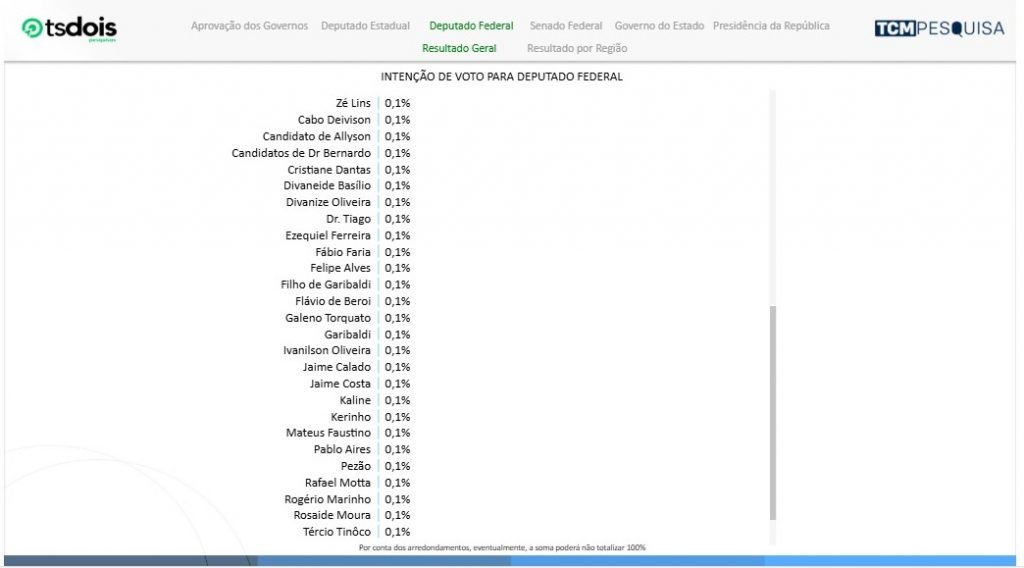
Natália Bonavides, General Girão e João Maia lideram pesquisa para deputado federal

A pesquisa TCM/TSDois traz, nesta quarta-feira (30), a intenção de votos para Deputado Federal considerando as eleições de 2026.

Não sabem/não responderam 77,8%. Branco/nulo/nenhum 8,8%. A deputada federal Natália Bonavides aparece com 2,5%. General Girão com 1,2%. João Maia 1,1%. Benes Leocádio 1,0%. Mineiro e Sargento Gonçalves com 0,6%. Robinson Faria e Kelps com 0,5%.

Confira nas imagens a seguir os demais nomes citados:

Dados da pesquisa

Foram entrevistados 1.847 eleitores, no período de 23 a 26 de julho de 2025, de todas as regiões e microrregiões, representadas por 63 municípios do RN. O nível de confiança utilizado é de 95%, com  2,5 pontos percentuais para mais ou para menos.

Acompanhe o Blog da Chris pelo Instagram

Categorias
Blog

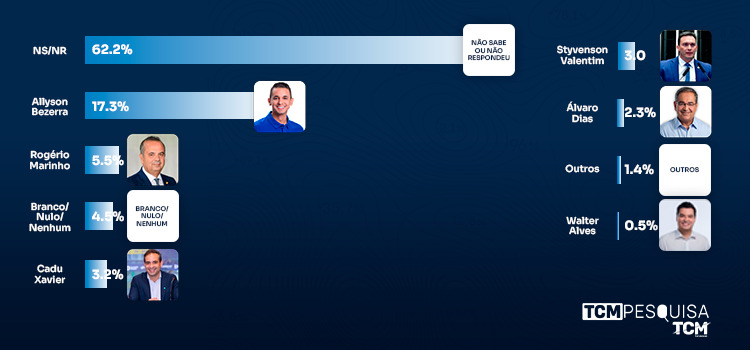
Allyson Bezerra lidera pesquisa com 17,3%

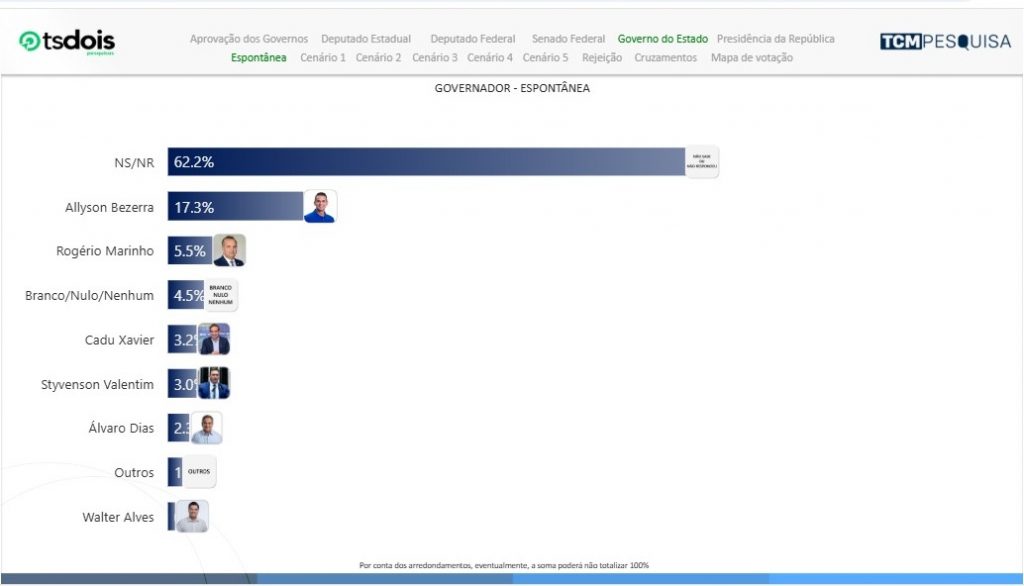
A pesquisa TCM/TSDois traz, nesta quarta-feira (30), a intenção de votos para o Governo do Estado do Rio Grande do Norte, considerando as eleições de 2026.

Na pesquisa espontânea, não sabem/não responderam 62,2%. Allyson Bezerra aparece com 17,3%. Rogério Marinho tem 5,5%. Branco/nulo/nenhum 4,5%. Cadu Xavier aparece com 3,2%. Styvenson Valentim com 3,0%. Álvaro Dias com 2,3%. Outros 1,4% e Walter Alves 0,5%.

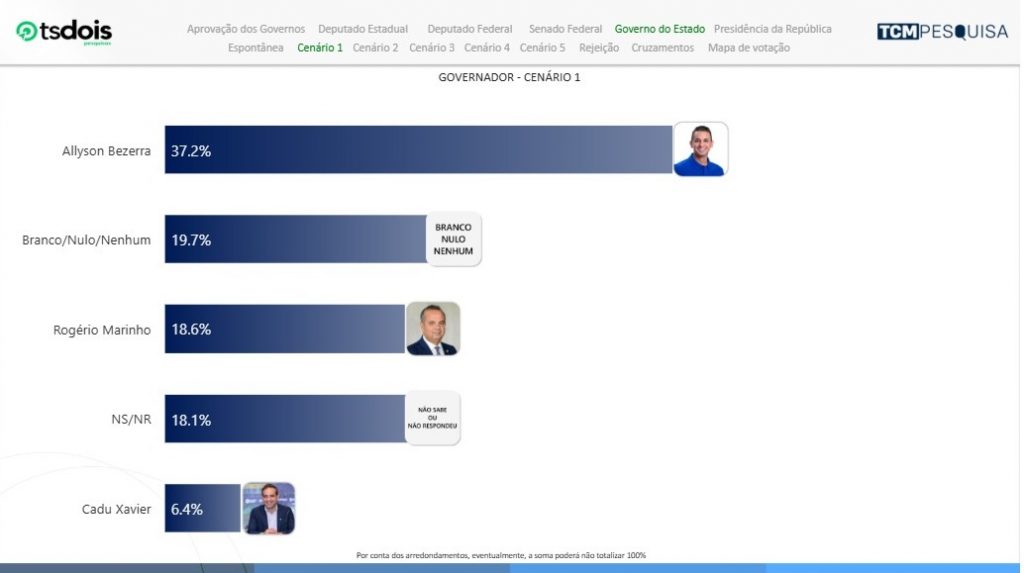
Na pesquisa estimulada foram apresentados cinco cenários. No Cenário 1, Allyson Bezerra aparece com 37,2% da intenção de votos. Branco/nulo/nenhum são 19,7%. Rogério Marinho com 18,6%. Não sabem/não responderam 18,1%. Cadu Xavier tem 6,4%.

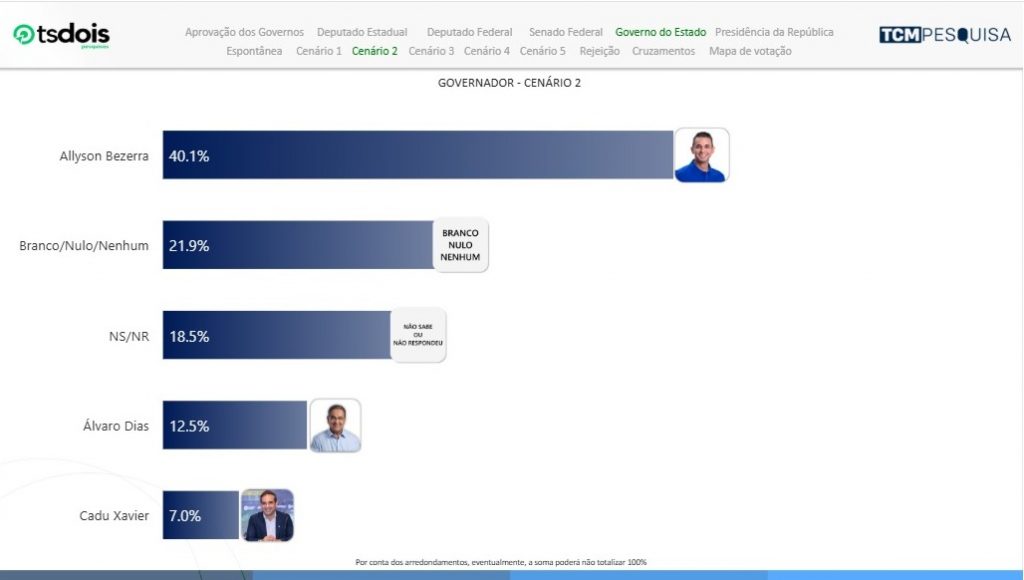
Para o Cenário 2, Allyson Bezerra aparece com 40,1%. Branco/nulo/nenhum 21,9%, não sabem/ não responderam 18,5%. Álvaro Dias surge com 12,5% e Cadu Xavier com 7,0%.

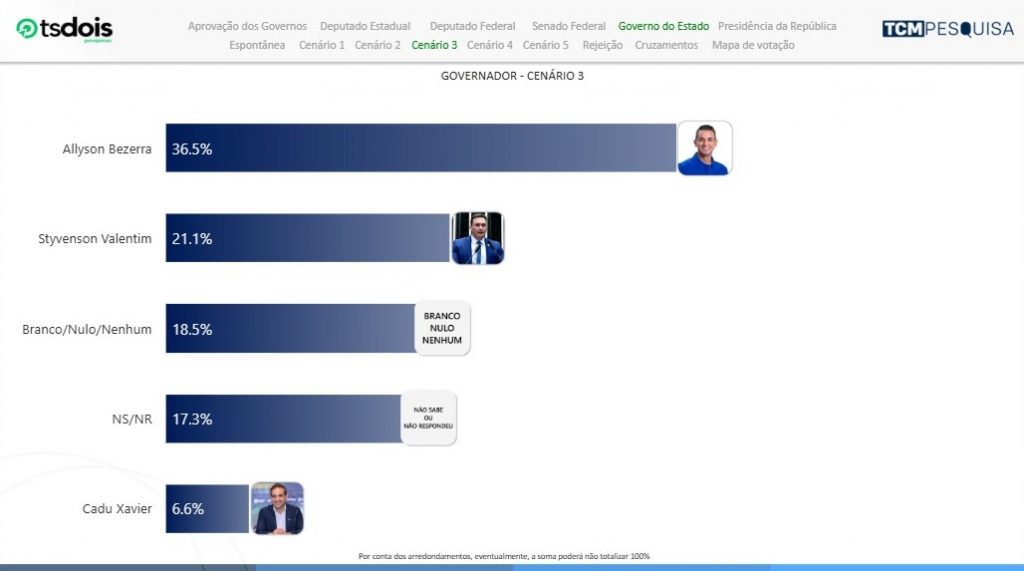
No Cenário 3, Allyson Bezerra vem com 36,5%, Styvenson Valentim com 21,1%. Branco/nulo/nenhum 18,5%. Não sabem/não responderam 17,3% e Cadu Xavier 6,6%.

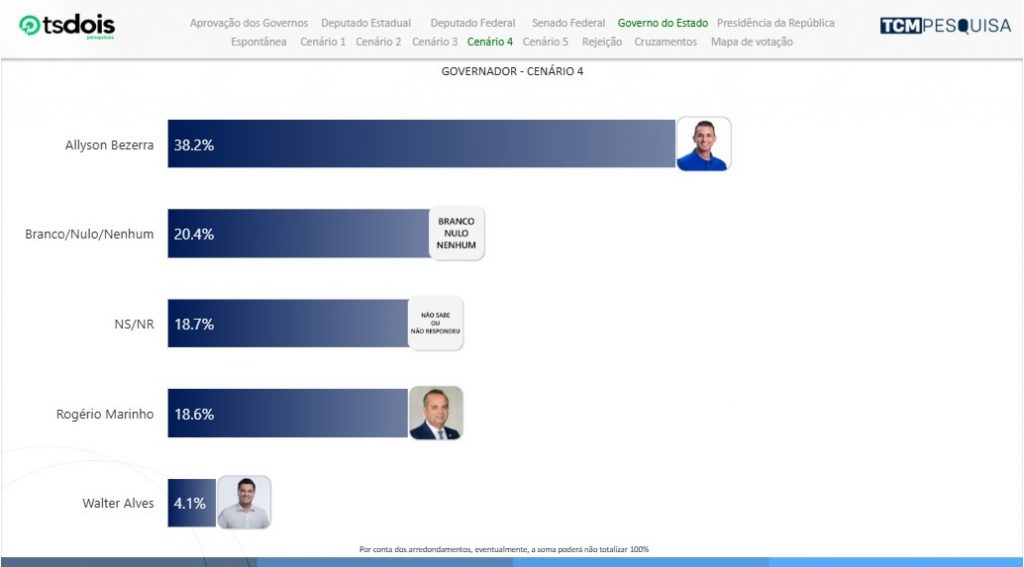
Já no Cenário 4, Allyson Bezerra tem 38,2% da preferência da intenção de voto para govenador. Branco/nulo/nenhum 20,4%, não sabem/não responderam 18,7%. Rogério Marinho aparece com 18,6% e Walter Alves 4,1%.

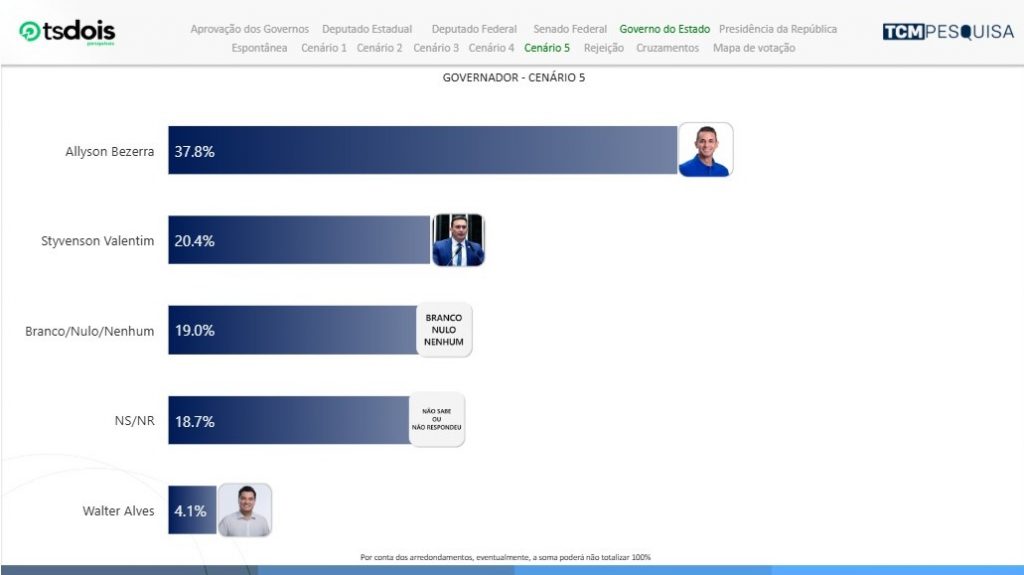
E por fim, no Cenário 5, Allyson Bezerra tem 37,8%, Styvenson Valentim 20,4%, branco/nulo/nenhum 19,0%, não sabem/não responderam 18,7% e Walter Alves aparece com 4,1%.

Rejeição

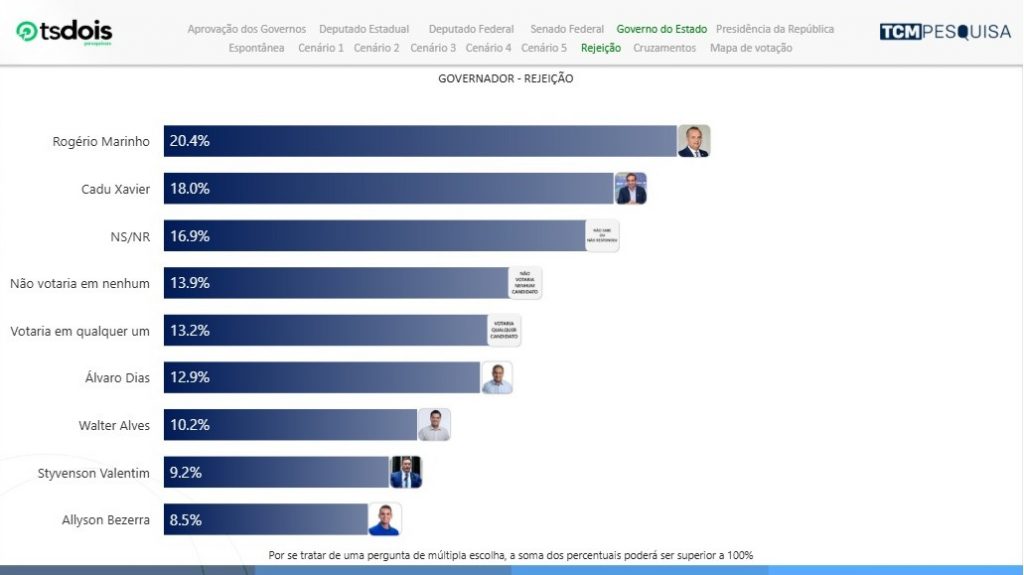
No quesito rejeição, Rogério Marinho aparece com índice de rejeição de 20,4%, Cadu Xavier tem 18,0%, não sabem/não responderam 16,9%. Não votaria em nenhum 13,9%. Votaria em qualquer um 13,2%. Álvaro Dias tem rejeição de 12,9%. Walter Alves 10,2%, Styvenson Valentim 9,2% e Allyson Bezerra 8,5%.

Categorias
Blog

No voto espontâneo Styvenson e Fátima aparecem tecnicamente empatados

A pesquisa TCM/TSDois traz, nesta quarta-feira (30), a intenção de votos para Senado Federal considerando as eleições de 2026.
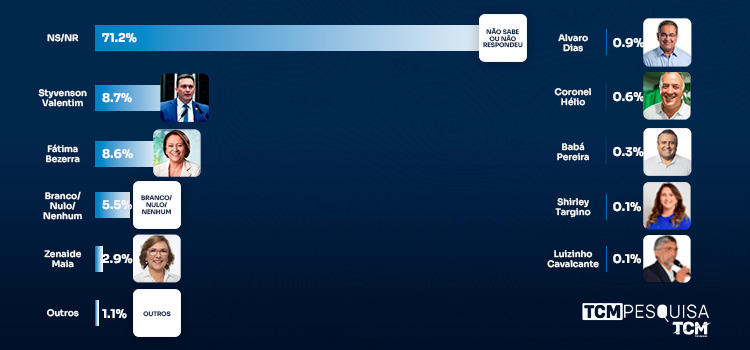
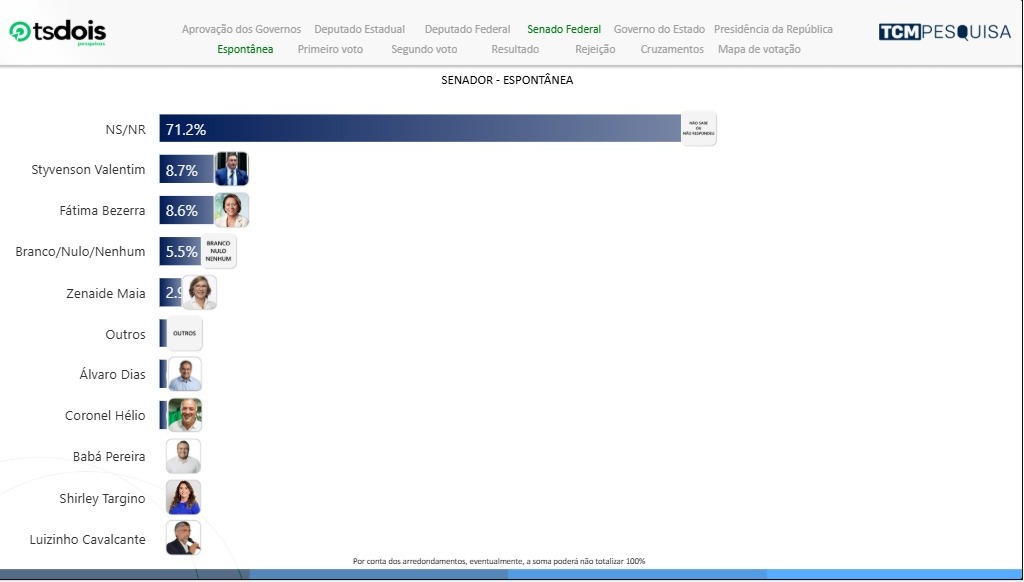
Na pesquisa espontânea, não souberam/não responderam 71,2%. Styvenson Valentim aparece com 8,7%. Seguido de Fátima Bezerra que aparece com 8,6%. Branco/nulo/nenhum são 5,5%. Zenaide Maia surge com 2,9%. Outros 1,1%. Álvaro Dias 0,9%. Coronel Hélio 0,6%. Babá Pereira 0,3%. Shirley Targino e Luizinho Cavalcante com 0,1%.

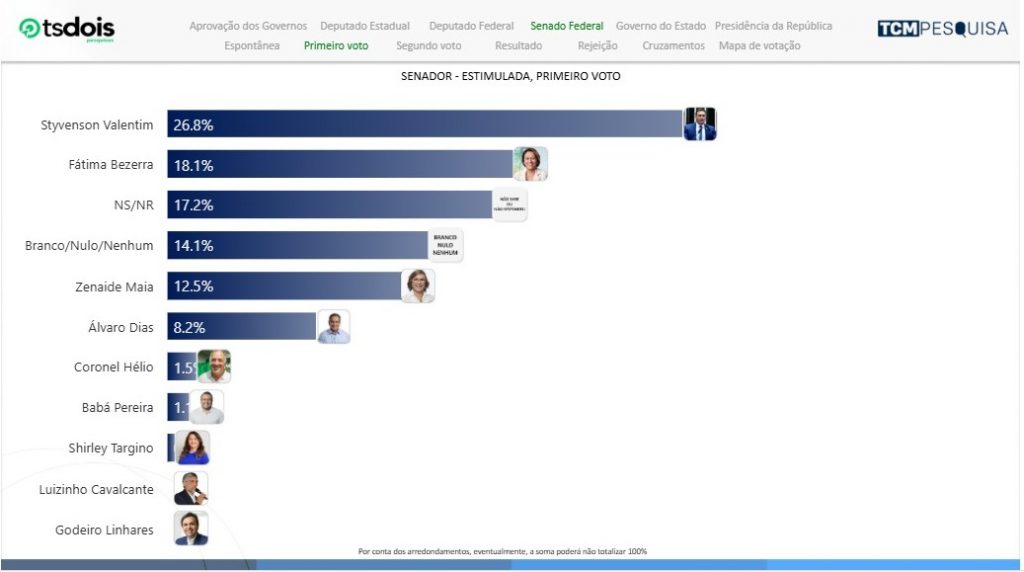
Na pesquisa estimulada, considerando o primeiro voto, Styvenson Valentim aparece com 26,8% e Fátima Bezerra com 18,1%. Não sabem/não responderam 17,2%. Branco/nulo/nenhum 14,1%. Zenaide Maia aparece com 12,5%. Álvaro Dias com 8,2%. Coronel Hélio 1,5%. Babá Pereira 1,1%. Shirley Targino com 0,4%. Luizinho Cavalcante e Godeiro Linhares com 0,1%.

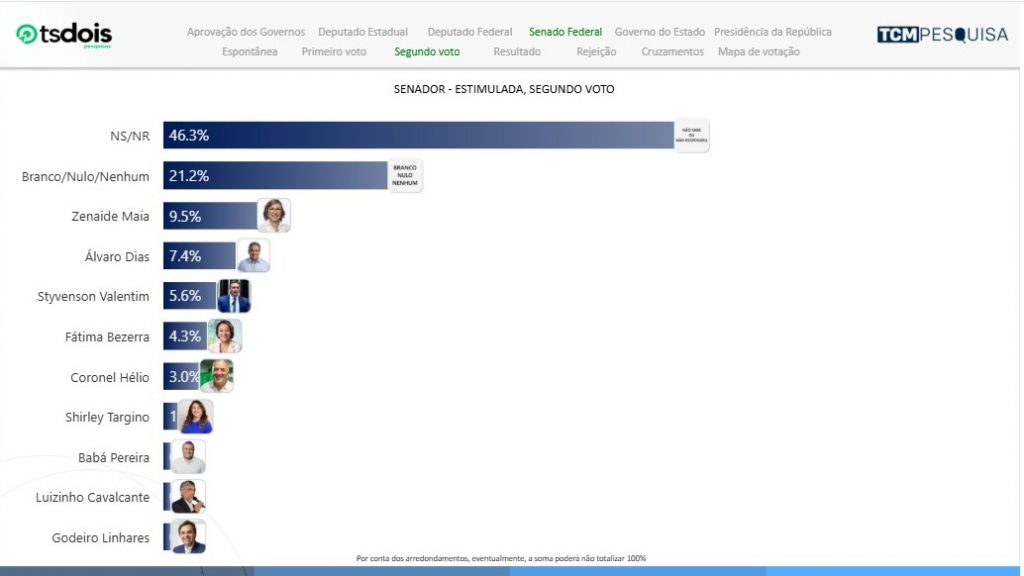
Já na pesquisa estimulada, considerando o segundo voto, não sabem/não responderam 46,3%. Branco/nulo/nenhum 21,2%. Zenaide Maia aparece com 9,5%. Álvaro Dias com 7,4%. Styvenson Valentim com 5,6%. Fátima Bezerra 4,3%. Coronel Hélio 3,0%. Shirley Targino com 1,1%. Babá Pereira e Luizinho Cavalcante com 0,6%. Godeiro Linhares com 0,4%.

Quando apresentado os votos válidos para Senador (primeiro e segundo voto), Styvenson Valentim aparece com 32,0%. Fátima Bezerra com 22,1%. Zenaide Maia 21,7%. Álvaro Dias 15,4%. Coronel Hélio 4,4%. Babá Pereira 1,7%. Shirley Targino 1,5%. Luizinho Cavalcante 0,7% e Godeiro Linhares com 0,4%.

Acompanhe o Blog da Chris pelo Instagram